
By Mitra Desai
The Rāmāyaṇa has travelled across centuries, languages, regions, religions and kingdoms. It has moved from Sanskrit into Hindi, Kannada, Telugu, Bengali, Assamese, Marathi and countless other languages. It has entered Jain and Buddhist traditions, folk traditions and oral narratives. It has travelled across the seas to Cambodia, Thailand, Indonesia and other parts of Southeast Asia. It has appeared in manuscripts and inscriptions, temples and palaces, paintings and sculptures, textiles and jewellery, music and dance, theatre and puppetry.
When it was retold, episodes were added, removed or transformed. Rama could be presented as god, a king or a hero. Sita could be portrayed through different cultural lenses. Hanuman could acquire far greater importance and Ravana could be portrayed as a learned king, a tragic figure, a devotee, or a deeply flawed antagonist.
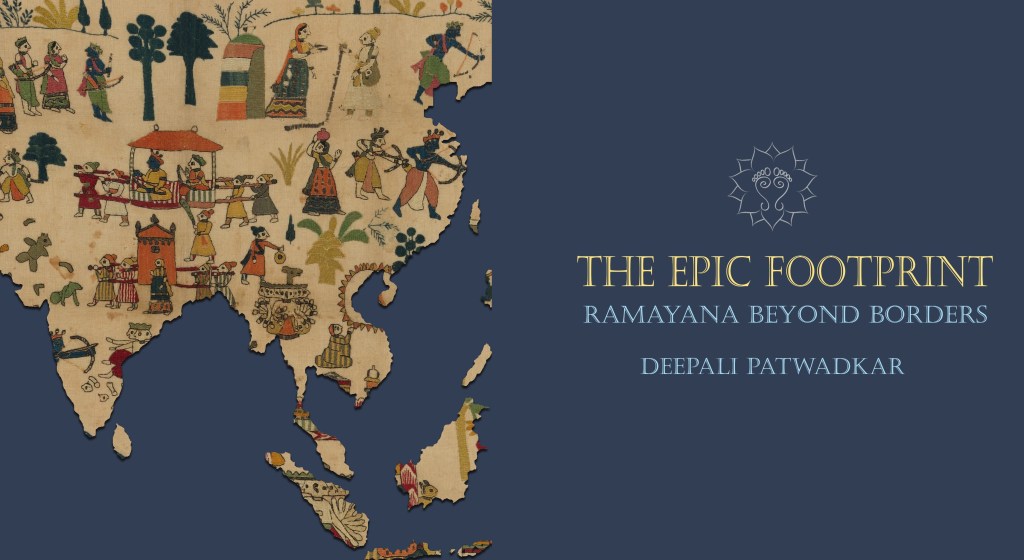
This extraordinary plurality is the starting point of Deepali Patwadkar’s book – The Epic Footprint: Rāmāyaṇa Beyond Borders. It begins at the earliest echoes of the Rāmakathā and follows its journey through a remarkably wide range of sources. It looks at the references to Rāma in the Vedic corpus, Vālmīki’s Rāmāyaṇa, the Rāmopākhyāna of the Mahābhārata, the Purāṇic traditions, Jain, Buddhist and Sikh narratives, Vanvāsī and oral traditions, classical Sanskrit literature and the many great regional Rāmāyaṇas.
The story is followed into Southeast Asia, where it acquires new languages, new artistic forms and new cultural meanings. It follows the path of Rāmāyaṇas travel to the West, to Europe and futher to the USA.
But the journey does not end with literature. The book follows the Rāmakathā into painting, sculpture, stamps, scrolls, coins, textiles, jewellery, games, music, dance and theatre. It looks at pilgrimage, cultural heritage, kingship, education, the freedom struggle and modern retellings.
The result is not a list of Rāmāyaṇas. It is a map of a civilisation’s engagement with an epic.
Why another book on the Rāmāyaṇa?
One might reasonably ask: haven’t we already established that there are many Rāmāyaṇas?
A. K. Ramanujan’s influential essay Three Hundred Rāmāyaṇ made precisely this plurality impossible to ignore. Through examples from Sanskrit, Tamil, Jain, Thai and folk traditions, Ramanujan demonstrated how differently the same narrative could be imagined in different cultural contexts.
That was an important intervention. But once we have recognised the plurality, another question arises. What do we do with it?
If one Rāmāyaṇa differs from another, what does the difference tell us? If a Jain poet changes the theological framework, does the story cease to belong to the Rāmakathā tradition? If a Śākta telling makes Sita the slayer of Ravana, what does that transformation reveal? If a Thai telling presents Ravana with greater sympathy, should we conclude that the Thai tradition has abandoned Rama? If Kampaṇ transforms an episode from Vālmīki, is that the only important fact about the two versions?
Epic Footprint takes the reader further. It does not dispute the differences. It celebrates them and shows the commonalities, uniting factors and the continuities in the traditions.
Consider the Jain tradition. The Jain Rāmakathā does not simply reproduce the theological assumptions of Vālmīki. Rāma is associated with the Jain ideal of ahiṃsā, and therefore does not personally kill Rāvaṇa. Lakṣmaṇa performs the killing. Rāvaṇa himself can be counted among the Mahāpuruṣas. Yet he is the Prativāsudeva, the great antagonist of the Vāsudeva.
The philosophical framework has changed. The roles have changed. Even the person who kills Rāvaṇa has changed. Yet, what Patwadkar points out is the uniting facator: Rāvaṇa is adharmic, and he has to be slayed.
The Śākta tradition can take the transformation further: Sita herself can become the slayer of Rāvaṇa. Again, the narrative has been radically reconfigured. But Patwadkar points out – that this Rāmakathā was churned in Bengal, the land of Śakti, and it came in a time when Bengal was under Islamic seige. This story urges the women to stand and fight, just as Sita slays Rāvaṇa.
This is the kind of commonality that Epic Footprint seeks to identify—not sameness of detail, but persistence of a larger narrative and cultural structure.
The Ahilyā episode provides another illustration. In Vālmīki, Kampaṇ and other traditions, the episode changes in significant ways. The nature of Ahilyā’s condition, the treatment of the curse, the role of Rāma and the theological meaning of the episode can all vary.
These differences are worth studying. But there is another question that is equally worth asking: What kind of culture allows poets to do this?
Patwadkar draws our attention to an extraordinary answer. The Hindu culture allowed for poets to inherit an ancient narrative and reinterpret it. They could disagree with earlier tellings. They could add and subtract. They could shift emphasis. They could bring their own philosophy and theology to the story. And their works could become part of the same larger cultural conversation. No poet or his work was banned or burned!
The Thai question
The Thai Ramakien offers another illuminating example. Ramanujan draws attention to the greater complexity and sympathy accorded to Rāvaṇa in the Thai tradition. His fall can be presented as tragic, and his love for Sita can receive a more sympathetic treatment than in Vālmīki’s narrative.
But in The Epic Footprint, Patwadkar steps outside the individual text and examines the larger Thai cultural landscape, we shows something equally striking. The Thai monarchy adopted the title Rama. Their capital Ayutthaya carried the name of Ayodhyā. Thus even if this tradition reinterpreted Rāvaṇa it did not make Rāvaṇa its cultural ideal.
This distinction matters. Rāvaṇa can be learned, musical, courageous, powerful and tragic, but he still remainas the figure whose actions brought about his downfall.
Beyond literature
Perhaps the most significant difference between The Epic Footprint and a study centred primarily on textual variations is its decision to follow the Rāmakathā beyond literature.
A literary text is only one form in which a civilisation remembers. The Rāmāyaṇa has been painted on walls, carved into stone, woven into textiles, performed through dance and theatre, transmitted through songs and oral traditions, represented on stamps and coins, incorporated into pilgrimage networks and invoked in ideas of kingship. A sculpture, a performance, a Subhashita, a folk song, a dohad song, a wedding song, a classical dance, a folk dance, a masked dance, an embroidery, a festival … Ramakatha takes many many forms.
These are part of its history, culture, art, spirituality and philosophy too. Patwadkar points that these traditions also become a livelihood for various communities.
What does The Epic Footprint tell us?
Patwadkar’s approach allows us to make an important distinction regarding Vālmīki. Recognising hundreds of Rāmakathās does not require us to deny Vālmīki’s foundational position within the tradition.
Vālmīki is remembered as the Ādikavi, and his Rāmāyaṇa as the Ādikāvya. Later poets may transform the story, challenge aspects of it, or interpret it through entirely different philosophical frameworks. Yet their very act of retelling participates in a tradition that has a history.
To acknowledge a foundation is not to deny the branches. Nor does acknowledging later creativity require us to treat every earlier form as irrelevant. A tradition can have an origin and still have innumerable manifestations. It can have continuity without uniformity.
The Epic Footprint takes the conversation beyond the insight offered by Three Hundred Rāmāyaṇas. Ramanujan leaves us with the fascinating discovery of plurality: there are many Rāmāyaṇas, and they can differ profoundly.
Patwadkar asks us to look at the bigger picture without getting lost in the differences. The fact that one tradition makes Lakṣmaṇa the slayer of Rāvaṇa, another makes Sita the slayer while yet another shows Rāvaṇa in symapthetic is significant. But, that should not blind us to the fact that in each version Rāvaṇa has to be slayed for his adharma.
Every telling deserves to be studied on its own terms. But after studying the individual trees, we must step back and appreciate the evergreen forest, lush, and vast called the Rāmāyaṇa.
The Epic Footprint is an invitation to see that forest.
 Deepali Patwadkar
Leave a comment