
“O Vanaras! You will then come upon an island called Shalmali Dweep. It is named after the colossal Kuta-Shalmali tree that stands on it. There you will behold Garuda’s magnificent mansion, adorned with countless sparkling jewels.”
These are Sugriva’s instructions to the Vanaras searching in the eastern direction. As he describes lands beyond the Ganga-Sagar and among the islands of the Indo-Pacific, he pauses to mention a place named after a giant Shalmali tree—the silk-cotton tree—and a magnificent abode of Garuda.
A few days ago, I found myself sitting beneath one such towering Shalmali tree in Cambodia.
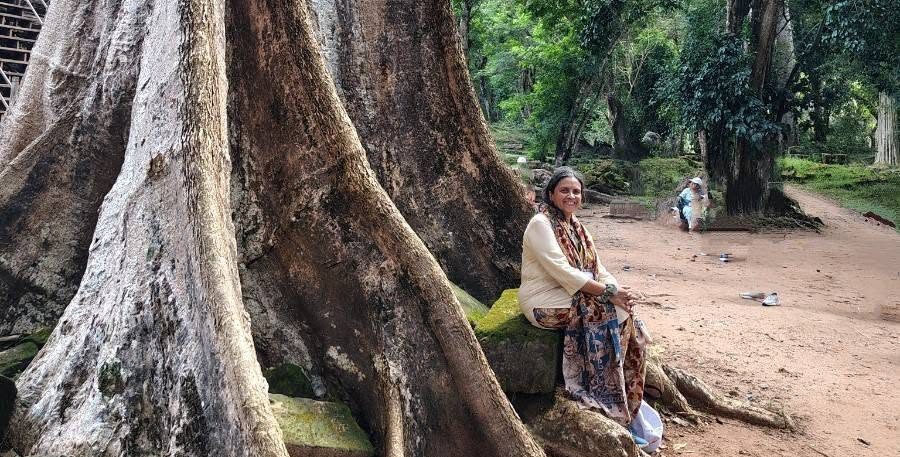
It was one of those moments when the pages of the Ramayana seemed to come alive.
All around Cambodia, Garuda is everywhere. He adorns temple lintels, carries Vishnu on his back, and appears repeatedly in the magnificent architecture of the Khmer civilization. These are not isolated motifs—they are part of a living artistic tradition that has flourished here for centuries.
Having worked on Sugriva’s Atlas with Nilesh Oak ji, tracing the geography described in the Ramayana, it somehow felt inevitable that I would one day follow Sugriva’s trail myself.
And so, with Virasat – Indian Heritage Initiative I found myself walking through Cambodia—not merely as a tourist, but as a student of Itihas, looking at the landscape through the eyes of Valmiki.
And there I was sitting beneath the very tree that an ancient poet described thousands of years ago.


Leave a Reply