
When we hear the phrase sustainable development, we usually think of solar panels, electric vehicles, recycling, climate change, or the United Nations Sustainable Development Goals. What if sustainability begins much earlier—not with technology, but with the way we raise human beings?
Long before sustainability became a global concern, India had developed a remarkably comprehensive system for nurturing individuals, strengthening families, and creating resilient societies. That system is called Saṁskāra.
Far from being a collection of religious rituals, Saṁskāras are a lifelong framework for shaping human character. They accompany a person from before birth to the final rites after death, gently preparing them for every stage of life.
What Exactly Are Saṁskāras?
The Sanskrit word Saṁskāra comes from the root meaning to refine, improve, or perfect.
Ancient scholars described it as a process that makes a person fit for a higher purpose. Just as raw gold is refined before becoming jewellery, human beings too require refinement—not merely education or skill training, but the cultivation of values, discipline, compassion, and wisdom.
This refinement happens gradually through different milestones of life.
A Life Designed for Growth
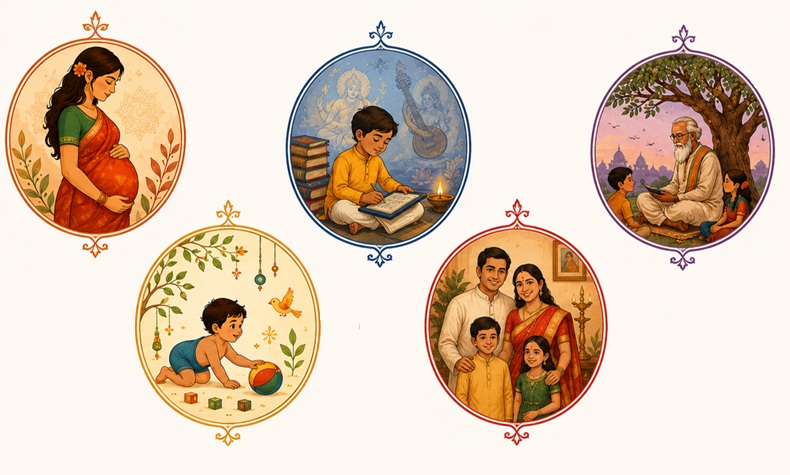
The classical tradition describes sixteen major Saṁskāras.
They begin even before birth, with rites that encourage conscious parenthood and the physical and emotional well-being of the mother.
Childhood Saṁskāras celebrate every important milestone—a child’s birth, naming ceremony, first outing, first solid food, first haircut, and birthday. These occasions do much more than preserve tradition. They create emotional security and make the child feel welcomed, valued, and connected to family.
As children grow, educational Saṁskāras prepare them for learning, discipline, responsibility, and independent thinking. The journey from Vidyārambha (beginning education) to Upanayana (formal initiation into disciplined learning) and finally Samāvartana (graduation) reflects a carefully designed progression toward adulthood.
Marriage marks the beginning of family life, while later Saṁskāras gradually prepare an individual for detachment, wisdom, and ultimately renunciation. Even the final rite, Antyeṣṭi, emphasizes continuity, remembrance, and gratitude toward one’s ancestors.
Rather than treating life as a random series of events, Saṁskāras give every stage purpose and direction.
Sustainability Begins with the Individual
Modern development often measures success through economic growth, literacy rates, or infrastructure. Saṁskāras measure success differently. They ask:
- Is the individual emotionally secure?
- Do they possess self-control?
- Can they distinguish right from wrong?
- Are they compassionate?
- Will they contribute positively to society?
This approach is preventive rather than corrective. Instead of trying to solve social problems after they arise, Saṁskāras attempt to prevent them by shaping character from childhood itself.
Strong Families Create Strong Societies
Many of today’s social challenges—loneliness, fractured families, anxiety, and declining trust—cannot be solved through laws alone.
Saṁskāras recognize that healthy societies are built inside healthy families.
Almost every Saṁskāra involves parents, grandparents, teachers, relatives, and the community. Values are not taught through lectures but through shared experiences, celebrations, rituals, and responsibilities.
Children grow up witnessing respect for elders, gratitude towards ancestors, care for nature, generosity, and service to society.
Culture becomes a living classroom.
Beyond Rituals: The Culture of Responsibility
The Saṁskāra tradition also includes practices that cultivate everyday responsibility. The Pañca Mahāyajñas, or five daily duties, remind every individual of their responsibilities toward:
- Brahma Yajna: Knowledge
- Deva Yajna: Nature and the Divine
- Pitru Yajna: Past and future generations
- Manushya Yajna: Fellow human beings
- Bhut Yajna: All living creatures
Similarly, the tradition encourages the cultivation of inner virtues such as compassion, forgiveness, purity, generosity, contentment, and freedom from greed.
These are not abstract ideals. They shape everyday behaviour and naturally create more harmonious families, communities, and societies.
Sustainability Is Also Cultural
Today’s sustainability discussions usually revolve around three pillars:
- Economic sustainability
- Social sustainability
- Environmental sustainability
But there is a fourth pillar that often receives less attention—culture. Culture determines how people consume, share resources, treat one another, educate children, and respond to challenges. Without an ethical culture, sustainable policies often remain temporary solutions.
Saṁskāras provide precisely this cultural foundation. They encourage moderation over excess, responsibility over entitlement, and long-term thinking over immediate gratification.
A Nation Is Built One Child at a Time
The strength of a nation does not depend only on its economy or military power. It also depends upon the character of its citizens.
For thousands of years, Saṁskāras have helped preserve India’s civilizational continuity by transmitting values across generations. They create citizens who possess discipline, resilience, compassion, and a sense of duty.
When individuals become refined, families become stronger.
Strong families build healthy communities.
Healthy communities create resilient nations.
This is sustainable development in its deepest sense.
A Timeless Model for the Future
Modern sustainability often focuses on repairing damage that has already been done.
Saṁskāras take a different approach.
They begin by nurturing the individual from the earliest stages of life, cultivating values before problems emerge, strengthening relationships before they weaken, and creating communities that naturally sustain themselves.
In many ways, Saṁskāras may be viewed as one of humanity’s oldest and most comprehensive models of sustainable development.
Perhaps the future does not require us to invent entirely new systems.
Perhaps it also asks us to rediscover the wisdom that has quietly sustained civilizations for millennia.
*This was presented as a paper at School of Management Sciences, Varanasi along with Prof. Amruta Kulkarni.


Leave a Reply