The Women’s Liberation Movement obviously demands her ‘liberation’. The question is, Liberation from what? What are the shackles that restrain her?
To understand this, we must travel back to pre-Christian Europe—a colourful mosaic of pagan civilizations: Greek, Roman, Nordic, Celtic, and Egyptian. These cultures worshipped many deities, including female deities like the goddesses of wisdom, victory, love, moon, and earth. In the Greco-Roman world, this reverence reflected in society: women could own property, run businesses, invest wealth, and even serve as priestesses. The divine world had space for women, and so did the human one.
This balance began to shift with the rise of Christianity in the 4th century. The first blow came in theology. The story of Adam and Eve portrayed the woman as the source of the “Original Sin,” condemning her to lifelong subordination and the pain of childbirth. The woman became subordinate in the divine narrative and gradually lost her place in society too.
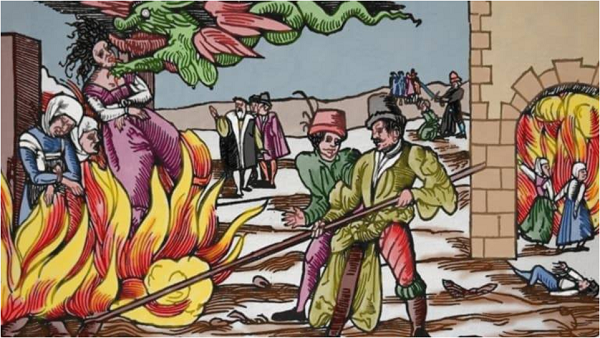
Agnes Sampson, a midwife from Scotland, used her skills to relieve birth pain. That was her sin! She had interfered with the will of God! As a punishment, she was burned at the stake for witchcraft in 1591.
| What Is Victoria’s Secret? In mid-19th century, even after advent of anaesthesia, women were denied its use during childbirth. Both medical and religious authorities believed that labour pain was God’s punishment for women and it should not be avoided. Queen Victoria too was denied chloroform during several deliveries. In 1853, during the birth of her eighth child, she could finally use chloroform. It was one of the earliest cases of pain-free labour. She praised it openly! Soon, ordinary women demanded painless labour. Though wider acceptance came only in the early 20th century, when the first wave of feminism pushed for safer childbirth and the right to pain relief. |
The Christian Trinity (possibly inspired by the Roman divine family of Zeus, Hera and Apollo) was that of the Father, the Son, and the Holy Spirit. It had no place for a mother goddess! The religious institution reflected this exclusion: there were Fathers and Popes, but no priestesses with authority comparable to those in earlier Greco-Roman world.
The centuries that followed saw Europe descend into the Dark Ages. Scientific thought was suppressed, libraries destroyed, and thinkers persecuted. Powerful women were silenced—like the philosopher Hypatia who was lynched by a mob, or Joan of Arc who was burned at the stake.
The Renaissance, Enlightenment and Protestant Movement did little to change the condition of women. Witch hunts swept across Europe, targeting women who practiced traditional healing etc. Hundreds of thousands of women were tortured and executed.
By the 18th century Europe was slowly coming out of the clutches of the Monarchy and the Church. French revolution serves as a fine example of this. Through this revolution Aristocracy was dissolved, lands owned by Church were confiscated by the state, democracy was established and the MEN of France were liberated! It took the women another 150 years of struggle to get their right to vote.
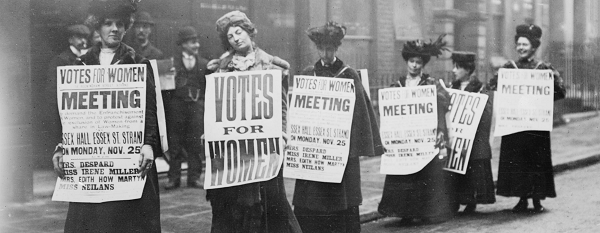
In the West, women were long denied the right to vote or contest elections. The Women’s Suffrage movement fought this injustice for long. In the United States, African American men gained voting rights in 1870, white women in 1920, and Black women only in 1965—nearly 180 years after the first elections. Britain took about 220 years to grant women the right to vote, while Switzerland’s last canton gave women right to vote as late as 1990.
In many European countries, abortion laws were long shaped by Church philosophy that prohibited termination of pregnancy. As a result, women were often denied abortion even when their health was at risk. In Ireland, for instance, it was only in 2013—after wide spread protests following the death of Savita Halappanavar—that the law allowed abortion when the mother’s life was in danger.
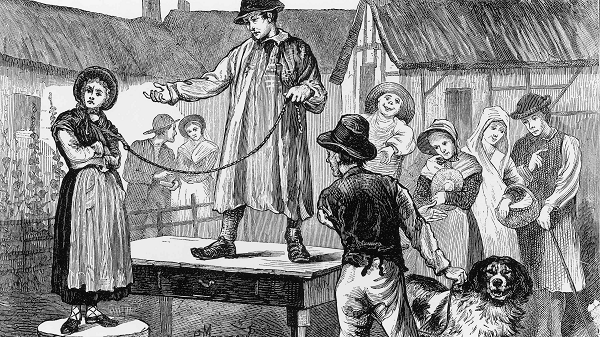
In England, the practice of wife-selling continued into the 19th century. A man unable to repay his debts could sell his wife in a marketplace. A rope was placed around her neck like a beast, and she was auctioned to the highest bidder. Such sales were even advertised in local newspapers.
It wasn’t until late 19th century that women could get higher education. Or on the matter of property rights, European husbands had legal authority over their wives’ savings, inheritance and property. Until 1985, a Swiss woman needed her husband’s consent for financial decisions.
These are but a few examples that highlight the value of a woman’s life in western countries. The women have had to struggle for centuries together to shed the tag of ‘being subordinate’. Their struggle gave rise to many movements such as – Women Suffrage, Women Liberation, Feminist Movement, Pro-choice Movements and others.
In the West, it took women more than a fifteen centuries to regain some rights their female ancestors had enjoyed in ancient Rome. Only in modern times did they secure basic rights, such as the right to education, to own property, to run businesses, to use anaesthesia in childbirth, to abort a pregnancy, to vote, and to contest elections.
Some barriers still remain including – Presidentship in the USA, Pope in any of the Churches, and the Goddess in the spiritual world.
References –
 Deepali Patwadkar
Leave a comment