
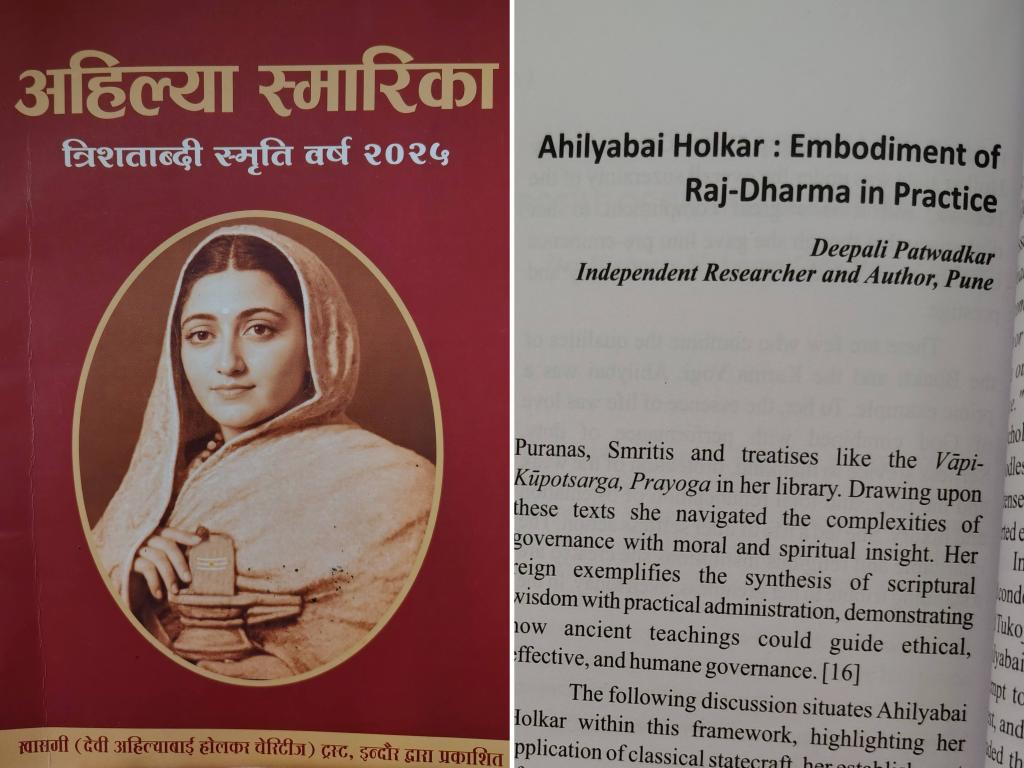
When we speak of ideal rulers in Indian history, Ahilyabai Holkar stands apart, not because she ruled vast territories or fought famous wars, but because she lived Raj-Dharma every single day. Her life shows us that Dharma is not an abstract idea found only in scriptures; it is something that can be practiced quietly, firmly, and compassionately in administration.
Born in 1725 and ruling Malwa during a turbulent period, Ahilyabai governed with a deep grounding in the wisdom of the Ramayana, Mahabharata, Puranas, and treatises like the Arthashastra. Her reign reminds us that ancient Indian texts were manuals for ethical living and responsible governance.
Ahilyabai’s day began at Brahma Muhurta. She listened daily to the Puranas from her Guru Ambadas Puranik. Her personal library included the Vedas, Upanishads, Smritis, Ramayana, Mahabharata, Puranas and texts on public works and water management. These were her working guides, her compass for decision-making. This grounding shaped her approach to governance, that was calm, thoughtful, and rooted in ethics.
Statecraft Without Bloodshed
After the sudden death of her son, Malerao Holkar, Malwa appeared vulnerable. Raghoba marched toward the region, encouraged by those who expected a power vacuum. Ahilyabai responded not with panic, but with wisdom drawn straight from classical statecraft:
उपायाः साम दानं च भेदो दण्डस्तथैव च ।
सम्यक्प्रयुक्ताः सिध्येयुर्दण्डस्त्वगतिका गतिः ||Use negotiation (sāma), alliance (dāna), creating strategic hesitation (bheda), and force (daṇḍa)—in that order.
Ahilyabai used the first three brilliantly to avoid the fourth and the most expensive option of war. She sent a piercing message to Raghoba: victory over a woman would bring him no glory while defeat would bring him shame. Either way, history would remember her. Raghoba retreated. Not a single soldier was lost.
In another incident, when Mahadji Scindia spoke lightly of seizing Malwa, Ahilyabai issued a firm warning. He never interfered again. Ahilyabai opted for peace through wisdom and treaties; but did not hesitate to draw the sword or to give capital punishment when need arose.
Wealth in the Service of Dharma
Ahilyabai clearly understood the relationship between wealth and righteousness, as the Mahabharata teaches:
धर्मः कामश्च स्वर्गश्च हर्षः क्रोधः श्रुतं दमः।
अर्थादेतानि सर्वाणि प्रवर्तन्ते नराधिप॥O King! Just as rivers originate in mountains, Dharma too originates in Artha. Only through wealth can one fulfill their duties—be it Pitru Dharma, Putra Dharma, or Rāja Dharma. Even your wishes, knowledge, discipline, and anger find meaning only when supported by wealth.
She increased Malwa’s revenue from 65 lakhs to 1.5 crores, how? Not by burdening people with extra tax, but by enabling prosperity. She supported traders, extended credit, encouraged industries like textiles, funded public works, and created employment. Farmers received tax relief during droughts. At the same time, accountability was maintained. Her economic policy was compassionate, yet disciplined.
Justice with Compassion
Ahilyabai knew that unchecked disorder destroys both kingdom and king:
यस्य राष्ट्रे प्रजाः सर्वास्त्रस्यन्ते साध्व्यसाधुभिः।
तस्य मत्तस्य नश्यन्ति कीर्तिरायुर्भगो गतिः ||If a kingdom is plagued by the misdeeds of the wicked, its king loses his reputation, longevity, wealth, and the promise of Swarga after death.
Tribal communities living in forests often looted travelers. Instead of treating them as criminals, Ahilyabai followed a deeper wisdom:
प्रजा सुखे सुखं राज्ञः प्रजानां च हिते हितम्।
नात्मप्रियं हितं राज्ञः प्रजानां तु प्रियं हितम्॥The king’s happiness lies in the happiness of his subjects. What benefits them is beneficial to him; not what pleases the king, but what pleases the people.
She gave these communities land, farming opportunities and collecting road-tax in return for traveler safety. Potential dacoits thus became protectors. Law and order were restored, not through fear, but through inclusion.
Restoring Temples, Rebuilding Society
Ahilyabai is remembered across India for rebuilding temples, ghats and wells. The Puranas say:
समुद्धत्य हरेर्द्धाम प्राप्नोति द्विगुणं फलम्।
पतितस्य तु यः कर्त्ता पतितस्य च रक्षिता ।।A person who repairs a falling temple gains double merit than the one who builds a new temple. Restoring or protecting a fallen temple is considered the highest virtue and leads one closer to the Lord’s divine abode.
From Kedarnath to Rameshwaram and from Dwarka to Puri, she restored sacred sites using her personal wealth. These projects revived art and architecture, pilgrimage networks, created employment, and built cultural confidence; all of this long before the term “heritage conservation” existed.
Water, Trees, and Ecology
Matsya Purana hails well-builders as heaven-bound. Ahilyabai dotted Malwa with lakes, step-wells, and smart water reuse—drought-proofing her land. Bhavishya Purana-inspired plantations of peepal, neem, banyans, mangoes, and more greened roads and farms. She built animal tanks, cattle pastures, bird fields, even fish feeders. Many ponds and goshalas thrive today.
Bharat as a Sacred Geography
Ahilyabai’s vision extended beyond Malwa. Guided by the Vishnu Purana:
उत्तरं यत् समुद्रस्य हिमाद्रेश्चैव दक्षिणम् |
वर्षं तद् भारतं नाम भारती यत्र सन्ततिः ||
Her work connected the subcontinent through pilgrimage routes and sacred spaces, nurturing cultural unity across regions.
A Queen of Simple Living
Despite immense resources, Ahilyabai lived a simple life, in accordance with the Bhagavad Gita. She wore plain white saree, lived in a modest home, and her court too was very simple. Her wealth flowed outward—to society, not inward to luxury.
Education as a Royal Duty
Ahilyabai believed that a king must educate the subjects, not merely collect tax. She established Sanskrit pathshalas and agrahars; organized public readings of sacred texts. In her rule, education, ethics, and culture were woven together.
Conclusion: Raj-Dharma in Action
न त्वहं कामये राज्यं न स्वर्गं नापुनर्भवम् ।
कामये दुःखतप्तानां प्राणिनामार्तिनाशनम् ॥
Like King Rantideva in Bhagavata Purana said, “I seek no kingdom or heaven, only to end my subjects’ suffering”—Ahilyabai too lived for serving her subjects and fulfilling her Dharma. She earned the title of Raja, which Mahabharata says is given to those kings who bring joy to their subjects.
Today, amid corrupt politics and environmental woes, Ahilyabai guides: Lead with wisdom, serve with heart. Her life proves Raj-Dharma isn’t ancient myth—it’s blueprint for tomorrow.
What timeless lesson from Ahilyabai resonates most with you? Share in the comments!
Sources:
Originally published as a paper titled “Ahilyabai Holkar: Embodiment of Raj-Dharma in Practice” in – Ahilyabai Smarika, 2025, Khasgi (Devi Ahilyabai Holkar Charities) Trust, Indore
Drawn from Life and Life’s Work of Shree Ahilyabai Holkar (V. V. Thakur), Vedh Ahilyabaincha (Devidas Pote), and classical texts like Yajnavalkya Smriti, Mahabharata, and Puranas. Full references in original study.
 Deepali Patwadkar
Leave a comment